Explore by topic

The story we tell ourselves about donated clothes is incomplete
Last updated: Sep 17, 2026
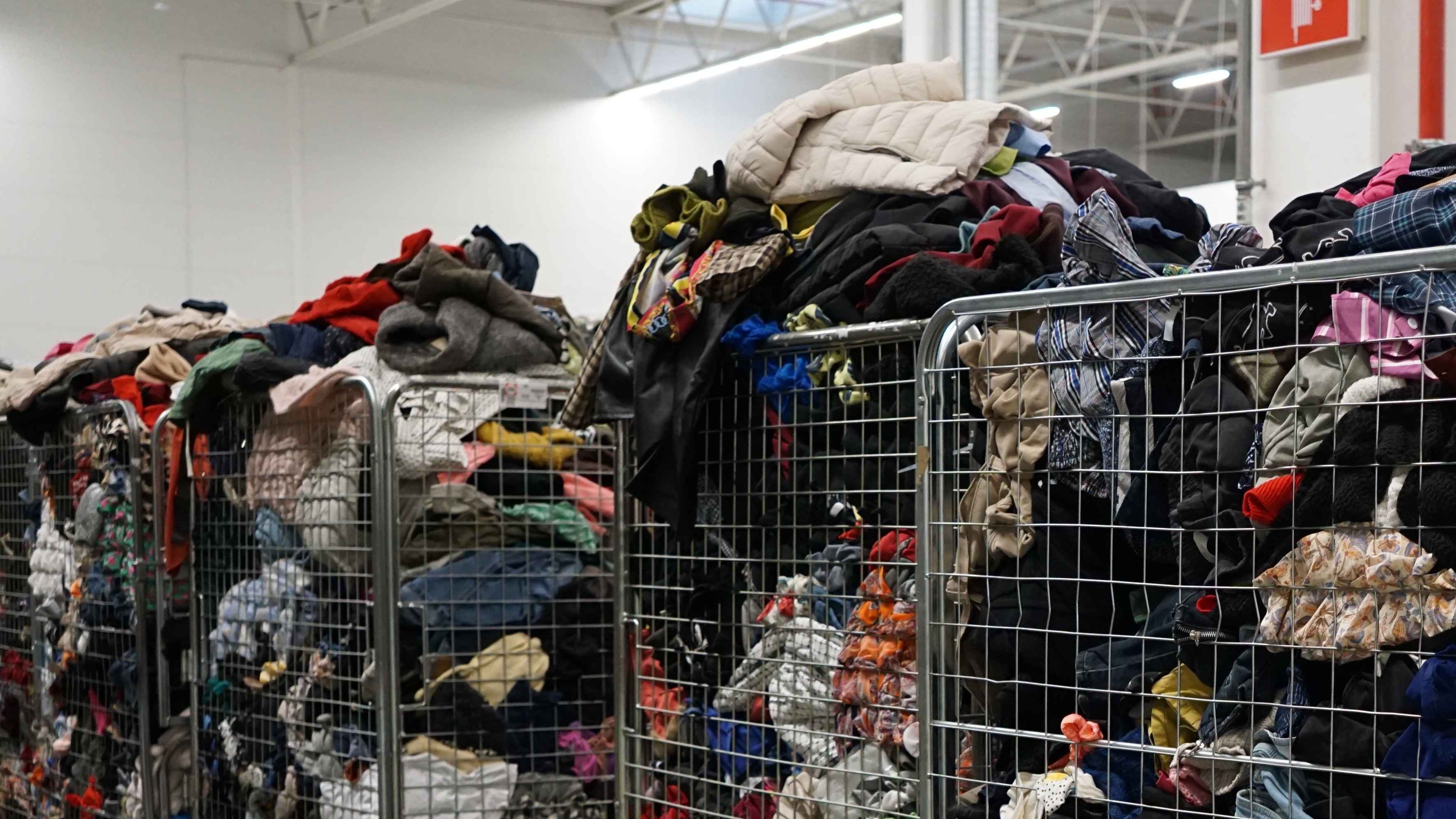
Photo from Luba Glazunova
Summary
Every year, millions of tonnes of used textiles leave Europe. Exports have tripled since 2000, reaching almost 1.7 million tonnes in 2023. Nearly half are destined for countries in Africa, while more than 40% are sent to Asia. For many consumers, this is where visibility ends. Yet the global trade in secondhand clothing raises an uncomfortable question: when clothes are reused, are we solving a waste problem, or simply moving responsibility elsewhere?
Rewear is not charity
The secondhand clothing trade is often framed as a success story, and in many ways, it is. Across Ghana, Pakistan and countless other countries, thriving reuse economies extend the life of garments, create jobs and provide affordable clothing. Traders, repairers, retailers, recyclers, and entrepreneurs extract value from items that might otherwise be discarded. These systems are among the most circular parts of the global fashion economy. But they are also under immense pressure and entangled with patterns of social marginalisation.
In Ghana's Kantamanto Market alone, an estimated 15 million garments arrive every week. Research conducted through Project Rewear found that 86.5% of sampled garments arriving in Kantamanto showed some form of damage. Traders often purchase bales without knowing exactly what they contain, taking on significant financial risk when garments prove difficult to sell. The burden of dealing with low-quality clothing—which is increasing in relative volume—does not disappear when garments leave Europe. It simply shifts to different actors further down the value chain.
This is why secondhand clothing is not charity. While consumers may give away their clothes for free, bales of exported used clothing are purchased at risk. Secondhand exports are a vast global industry, one that generates livelihoods and value, but also concentrates many of the costs and risks in importing countries.
The transparency problem nobody talks about
Perhaps the most surprising finding from Project Rewear was not what researchers discovered, but what they couldn't. Textiles intended for reuse are exported under customs codes for secondhand clothing. Yet garments that are damaged, poor quality or commercially undesirable can also end up in these exports. Because shipments are rarely inspected in detail, it is difficult to distinguish genuinely reusable clothing from material that is likely to become waste shortly after arrival.
This lack of transparency creates blind spots throughout the system. Importing countries struggle to anticipate waste volumes and infrastructure needs. Exporting countries can continue to report high collection and reuse rates without fully understanding what happens next. The result is a system where everyone sees part of the picture, but nobody sees the whole thing. This fragmentation leaves questions of responsibility unanswered: who is responsible for the environmental harms caused by textiles that inevitably become waste somewhere? Who bears the cost of declining quality that undermines long-established secondhand markets? And who is responsible for the ever-increasing volumes that are driving the waste problem?
The good news: Most clothes aren't worn out
These interlocking problems aren’t going away, but the report also points to opportunities. Researchers analysed more than 8,000 garments across sorting facilities in the Netherlands, Spain, Poland and Lithuania. They found that 37% showed no damage at all, while a further 41% had only minor flaws. In other words, most garments entering the sorting system were still wearable.
Perhaps the report's most important insight is that clothing is rarely discarded because it is beyond repair. More often, it is discarded because the economics don't work. Cleaning, repairing, depilling or preparing garments for resale often costs more than the value that can be recovered. In a market saturated with cheap new clothing, extending a garment's life can simply be too expensive. Therefore, the challenge is not a lack of usable clothing but a lack of incentives to keep that clothing in circulation.
Building a better business case for rewear
This is where some of the most interesting innovations are emerging. Rather than focusing solely on recycling, innovators are exploring how to preserve the value already embedded in garments. For example, Save Your Wardrobe developed an open-source Aftersales Diagnostics Tool that helps brands identify where repair and care services can create value, reduce costs and generate new revenue opportunities. United Repair Centre demonstrates how repair can increase the value of garments that would otherwise be exported into lower-value markets. By repairing and creatively restoring clothing, the company shows that garments can remain in higher-value reuse systems for longer. Meanwhile, reverse.fashion explores how AI-powered sorting tools can help operators identify the highest-value destination for garments more efficiently, improving value capture and reducing waste.
These may sound like small interventions, but they point towards something bigger. For years, reuse and repair have often been treated as environmental obligations—important, but difficult to scale commercially. Project Rewear suggests a different possibility: that under the right conditions, rewear can make business sense too.
Innovation won't solve everything
The findings also highlight the limits of focusing exclusively on downstream solutions. Rewear creates jobs. It extends product lifetimes. It reduces demand for virgin resources. It is a critical part of a more circular fashion system. But it cannot keep pace indefinitely with rising production volumes. Today, the fashion industry produces far more clothing than global reuse markets can realistically absorb. As garments become cheaper and trends move faster, more value leaks out of the system before clothes have reached the end of their useful lives. In this context, rewear risks becoming a parallel market that manages fashion's excess rather than addressing its cause. That doesn't diminish its importance. If anything, it makes it more urgent.
The communities, traders, and innovators working to keep clothing in circulation are demonstrating what a more resource-conscious fashion system could look like. They are finding value where others see waste. But the ways that ‘value’ and ‘waste’ are defined in the current system continue to be shaped by global inequalities. What is discarded in high-consumption, high-disposal countries as ‘waste’ is often revalued elsewhere: through recycling networks in Pakistan, through upcyclers and other circular innovators in Kantamanto. Yet rather than looking to these spaces as loci for circular innovation—and as models for clothing cultures built around value retention and care—the fashion industry continues to reproduce a system sustained by the exploitation of people and planet and by a logic of disposability.
If we want rewear to fulfil its potential, and enable existing rewear cultures and economies to influence how the fashion system operates, we need to stop seeing it as a convenient endpoint for unwanted clothes. The question, then, is not whether our old clothes deserve a second life, but why so many clothes lose their value after such a short first life.
Citations
- https://www.eea.europa.eu/en/newsroom/news/consumption-of-clothing-footwear-other-textiles-in-the-eu-reaches-new-record-high
- https://ce-assets.prod.circularity-gap.world/FFG_x_Circle_Economy_Project_Rewear_fa69e780ee.pdf
- https://www.circle-economy.com/knowledge-hub/article/tyt7?title=Sorting-for-Circularity-Project-REWEAR
- https://www.saveyourwardrobe.com/en-gb
- https://www.unitedrepaircentre.com/
- http://reverse.fashion
Contributors
Owner
Date added: Sep 17, 2026
Last updated: Sep 17, 2026
More from Circle Economy



Add your content
Strengthen the circular economy knowledge base by adding a report, case study, publication, or other resource to our platform!