Explore by topic

Closing the Loop with HDPE: Fifty/50 Wheelie Bin
Last updated: Oct 1, 2021
Summary
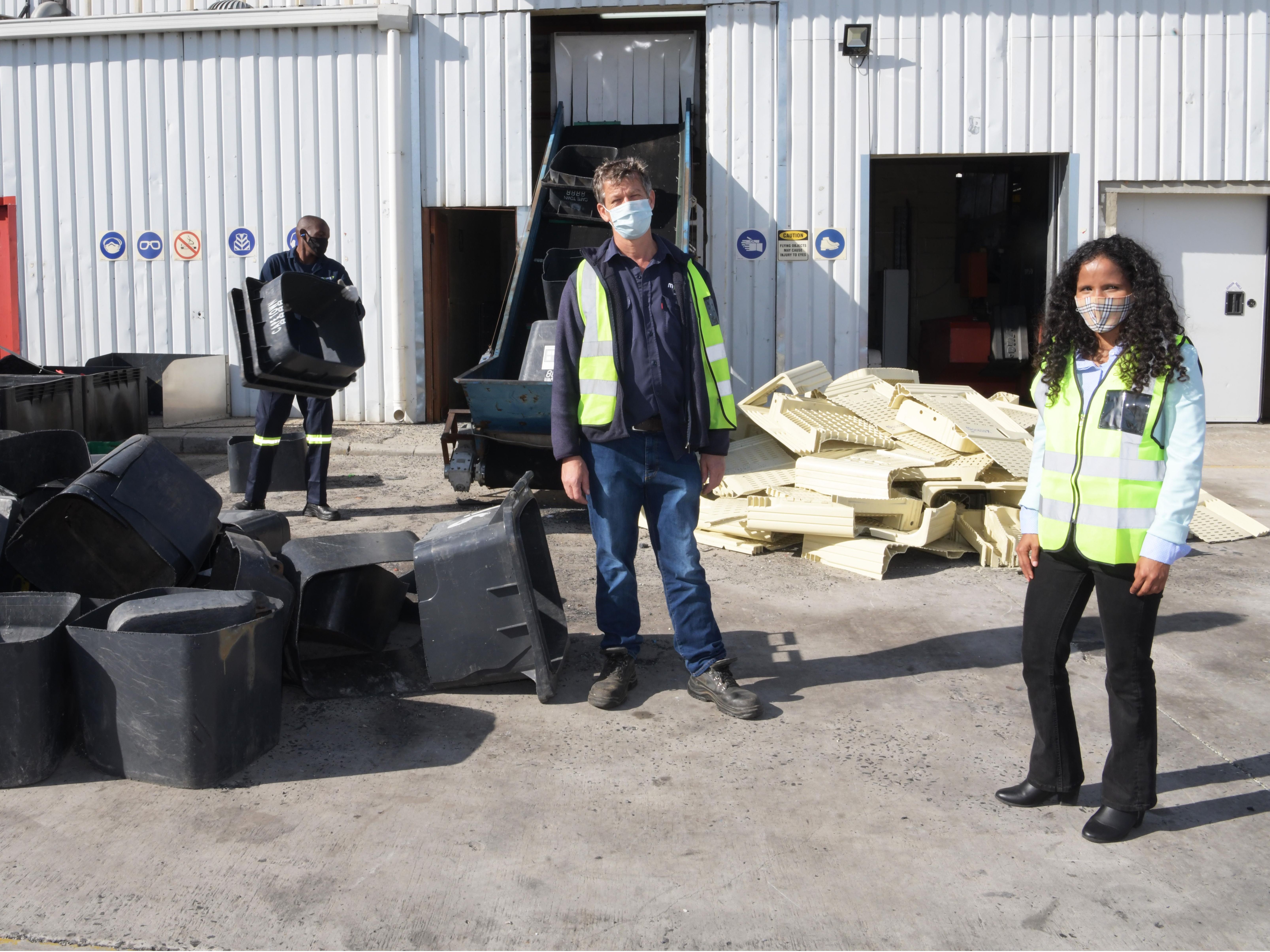
Cape Town’s innovative Fifty/50 Wheelie Bin Initiative, led by the Solid Waste Management Department, is using material from broken, past-their-lifespan wheelie bins to produce new ones. The initiative is a great example of circular public procurement that has allowed the City to become a leader in building resilience through circularity while offering a sustainable waste management option for residents by providing closed-loop recycling bins. The Fifty/50 Wheelie Bin Initiative has proven to be successful in lowering emissions, saving space and materials, saving costs, and creating secure jobs.
Problem
In South Africa, often local municipalities are mandated by the constitution to provide waste management services to citizens. The City of Cape Town (CCT) provides this service by collecting residents’ refuse bins. By the end of 2019, the CCT was servicing an estimated total of 925,000 bins. The municipality usually procures these bins from the private sector, through a highly regulated tendering process. Until 2014, these bins were made from 100% virgin high-density polyethene (HDPE) plastic, mostly imported from outside of the country. This material is hardy and durable, which makes it a good choice for hard-wearing items that are exposed to a harsh operating environment, but it is not biodegradable and, when it reaches the end of its usability, takes up a substantial amount of limited landfill airspace if not recycled. Given the high impact of bins, in November 2014, the CCT came up with a different strategy to ensure that these bins could provide more value to the city, as well as offer sustainable long-term benefits to its citizens.
Solution
The CCT leveraged its procurement policy and included more progressive and more environmentally-friendly tender specifications for the procurement of refuse bins. Specifications included, for example, that bins had a minimum lifespan of 10 years, were 100% locally produced, that the producer includes HDPE material salvaged from condemned, damaged, or past-lifespan bins to create new bins, and that bins were made up from at least 50% HDPE recyclate—from here their name ‘Fifty/50 wheelie bins'. The new specifications are thereby ‘closing the loop’ on a public procurement process, substantially improving its environmental impact.
Outcome
The project has been able to divert more than and recycle these to create new bins, resulting in more than. The Fifty/50 programme will serve as a great example for other cities to leverage on their procurement policy to tangibly facilitate circularity at scale and build a resilient urban system. More specifically, the CCT has embedded circular procurement principles to not only divert waste from its own landfills, but to also reduce its own bin disposal liabilities, secure end-markets for HDPE plastic recyclers, create new circular jobs, and, more importantly, ensure that jobs and businesses weather global crises. All this without compromising price, quality, and functionality, and longevity of the bins.
Measurable benefits by this initiative:
- 1,2 million kgs of condemned bins diverted from landfill
- 850 000 Fifty/50 wheelie bins ‘in the field’ (and eventually all City-issued wheelie bins will be replaced with the Fifty/50 version).
- 18 865 ‘free’ bins provided over the past 6 years, saving the City approximately R7,4 million at current tender prices, since the tender requires that in exchange for every 65kg of broken/condemned bin material provided as recycling ‘feedstock’ to the contractor, one free 240 litre wheelie bin is provided to the City.
- 378 328 Fifty/50 wheelie-bins procured and already in use, providing a refuse collection service to the public, which translates to an additional R10,4 million in savings as these bins are about R28 cheaper each.
- R18 million total cost-savings, of which R600 000 only in landfill gate fees.
- More than a million kgs of HDPE diverted from landfill and incorporated into a circular economy
- 1053-1121 m3 of landfill airspace saved
- 1 708 tons of 2CO2 saved
- 13 permanent and 18 part-time jobs created
Location
Industries
Key elements of the circular economy
Attachments and links
Contributors
Owner
Contributor
Contributor
Date added: May 20, 2021
Last updated: Oct 1, 2021
More from the contributors


Add your content
Strengthen the circular economy knowledge base by adding a report, case study, publication, or other resource to our platform!